
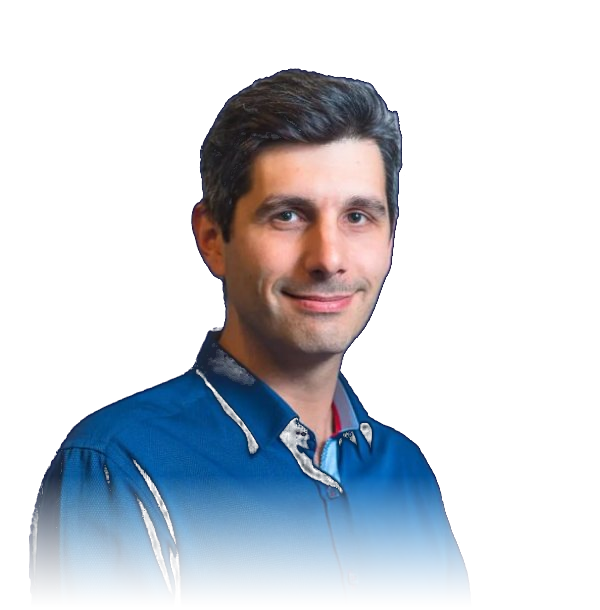
Marc Kaplan is the CEO and co-founder of VeriQloud, a French company building applications and software for quantum networks. He spent more than ten years in academic research before co-founding it with Elham Kashefi, a pioneer of secure quantum cloud computing. Their bet: quantum key distribution alone won't build the quantum internet, so VeriQloud's Qline hardware runs many applications on one stack, with no proprietary parts. We talked in June 2025. We covered what Q-Day really means for the information society, the confusion between QKD, quantum cryptography and the quantum internet, why Qline is a white box, and why he sees blockchain as the first real market for quantum networks.
What Marc said in the clips
Q-Day and the end of the information society
How do you see Q-Day, the day quantum computers can break classical encryption, impacting cybersecurity?
I see cryptography as a way to enforce trust using mathematics. If you can break the mathematics, as we know quantum computers can, there is no way to have trust anymore. It's literally the end of the information society. That's what Q-Day means. You can't trust any computer on the internet anymore. You can't connect to your bank. You can't purchase anything. You can't even guarantee that an email comes from a legitimate person.
There is a fix: transitioning to post-quantum cryptography, cryptographic systems using mathematics that resist quantum attacks. It was standardized recently by NIST in the US, so it's ready for deployment. It's a tricky deployment, but it's ready.
I don't know when quantum computers will be there. That's a bet I'm not willing to make. But I know that the day we have quantum computers, some of the data we encrypt today will still need to be secure: genomics data, personal data, military secrets. That kind of data has a lifespan of 50 years or more. So we need to change the encryption today. Or even yesterday.
QKD, quantum cryptography, quantum internet
Are there misconceptions about quantum networking you'd like to clear up?
In quantum networking, there's a huge confusion between quantum key distribution, quantum cryptography and the quantum internet: how they differ, and what each one does.
Quantum key distribution is the current stage of quantum networks. It does one task: point-to-point key establishment. Then comes quantum cryptography, with lots of different tasks, such as encryption. And the long term is the quantum internet, in which quantum computers get connected to quantum networks.
One stack, many applications
What inspired you to co-found VeriQloud, and what is the vision?
My co-founders and I had each been in academia for more than ten years. We knew that in quantum networking, the academic literature had a lot of applications. But when we looked at industry, there was only one: quantum key distribution. We identified that gap and wanted to fill it.
Can you give a high-level description of your technology?
On the hardware side, it's very similar to quantum key distribution: a box that emits single-photon states and runs on a network. By network I mean standard optical fiber, the same fiber that connects the internet to our homes.
On the software side, we develop a number of applications beyond QKD. We've demonstrated that our hardware can run several of them, quantum secret sharing and secure classical computing, for example. We also showed that the same hardware we use for QKD today can be used for secure quantum cloud computing. It's quite unique to have a stack that runs several applications rather than just one.
Why Qline is a white box
VeriQloud recently repositioned Qline around an open, white-box hardware approach. How does that support the development of quantum networks?
Who is developing QKD today? Mostly telecom operators. In Europe we have the EuroQCI project: of the 27 member states, 26 have their own QKD testbed. What we learned by talking to these people is that their main need is to experiment with the technology and learn how to integrate it into their network stack. They know how to run a network. They don't know how to add a quantum layer on top. The main focus of quantum communication today is not production-grade networks, but experimental ones.
So there is no proprietary part in Qline. Customers have access to everything: the blueprints of the hardware, the photonics, the scripts, the log files. That lets them experiment with network architectures beyond point-to-point, like star architectures, or multiplexing several quantum signals in the same optical fiber. These things are very hard with off-the-shelf hardware that may be very efficient, but is a closed environment.
There are well-established companies selling very good QKD hardware, but they're dedicated to that one task. In my opinion, QKD hasn't been able to create a circle of innovation, where large adoption leads to improvement and then to the next stage. Our belief, or our bet, is that to create that circle, we need to work on applications, and we need adopters who run them and then ask for more.
Blockchain and unclonable cryptography
What are the most promising real-world applications of quantum networks beyond QKD?
In the shorter term, rather than identifying an application, we try to identify the right field. Our conclusion is that it's the blockchain world. There, the need for security is so high that any small improvement will be adopted by the community.
Blockchain should care about quantum networking because quantum networks let you perform tasks that are literally impossible with classical networks. This field is now called unclonable cryptography: you take advantage of the fact that quantum information can't be cloned to perform new cryptographic tasks. Quantum tokens, for example, come with a physical guarantee that they can't be cloned. With unclonable encryption, you can store data on a server with a physical guarantee that the server can't copy it somewhere else. And with certified deletion, you can ask the server to delete your data, and it can prove mathematically that the data is gone.
To reach that community, we're working on specific developments, which we'll communicate about in the coming months.
This interview has been edited and condensed for clarity.

