
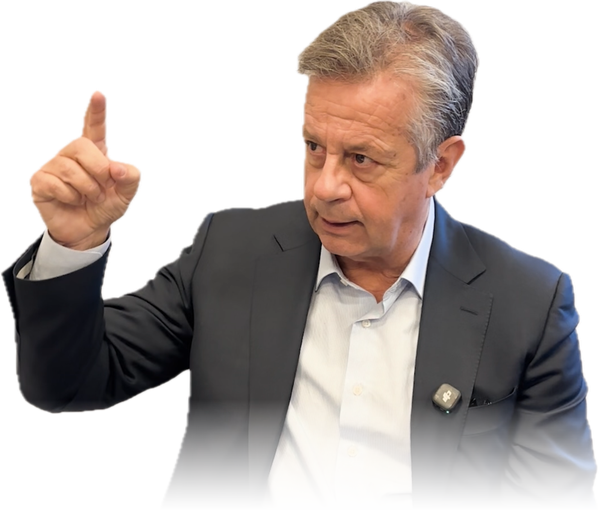
Carlos Moreira is the founder and CEO of SEALSQ and WISeQey, formerly WISeKey. He leads three publicly listed companies, each covering one layer of the stack. SEALSQ makes the chips: trusted, quantum-resistant hardware, or as we like to call it, TQR. WISeQey is the identity layer, giving every chip and device a digital passport nobody can forge. And WISeSat takes the whole stack into orbit, with small satellites securing devices anywhere on Earth. We spoke the day SEALSQ announced that its post-quantum chip had passed one of the toughest independent security tests in the industry. We talked about the difference between standard, trusted and secure, why he believes trust is local but security is global as export controls tighten, and his goal of putting a satellite in orbit for the price of a car.
The interview
A certified post-quantum chip
This morning you shared some major news. What does it change for SEALSQ and the direction of the company?
Last year we demonstrated the QS7001, a semiconductor with post-quantum capability. It will be able to defend against a quantum attack once quantum computers have enough qubits to break RSA and traditional encryption. We demonstrated it last year, but we didn't yet have the certification, which is a very lengthy process. The chip has to be attacked by laboratories, they issue recommendations for improvement, and all of that took a year.
We got it just yesterday. The timing was a bit accidental, but yesterday we received the letter from SERMA, the laboratory in France, saying the chip is post-quantum ready and will defend against a quantum attack. It's based on Common Criteria, the gold standard in certification. It's similar to other industries: an airplane needs to be certified before it can fly, and a medical product needs FDA approval before it reaches the consumer.
Congrats. You said something this morning I found very interesting: you're mainly focused on hardware, and certification brings a credibility that software PQC companies don't have. Can you explain that, and your focus on identity?
PQC software is available. We do software as well, but that part is easy. The barrier to entry is very low: you can take the NIST algorithms and open-source libraries like liboqs and build your own environment, especially now with AI coding. What's difficult is taking that software and injecting it physically into the object, via a chip. The chip becomes the anchor where you store the keys, protected by the software layer.
That's our focus: certifying objects. We're less focused on securing people, because companies like SAP or Cisco, who provide the backend, will do that. We can help them move to PQC, but we focus on objects, because that's where the market is. Trillions of objects are getting connected and they need that level of security: drones, airplanes, electric vehicle chargers, a whole new infrastructure of objects connecting to the internet.
PQC software doesn't require certification. Companies can say they're secure, but we never know what's behind it. A trusted third-party certification is essential.
Is there a difference, for you, between something being standard and something being secure?
Yes. There's standard, trusted, and secure. Things can be standard and trusted because a government regulatory process says so. But take that product to another country and you lose that. Security certification is agnostic to political pressure. These are independent labs with no financial stake. For them, either you're safe or you're not.
Building a quantum body
I actually made a map of SEALSQ and all its quantum companies. How do you see the ecosystem you're building?
SEALSQ, the S for semiconductor and the Q for quantum, is trying to become the integrator of the technologies floating around the quantum ecosystem. You have quantum sensing, QKD (quantum key distribution), quantum pure plays, all built by different types of companies. Bringing them together is very complicated, and end users don't want that complexity. A bank doesn't want to buy a quantum computer that might cost $200 or $300 million, plus a quantum router, quantum sensing and QKD. They want to plug into something and get the result without worrying about the architecture.
So we're doing that job ourselves: verticalizing the stack, adding all those layers, then plugging in customers so they can tell us whether it meets 100% of their needs. QKD, for instance, is very new and will only be available from space, which requires satellites, and a bank isn't going to launch satellites.
That has been our investment over the last few years. We've invested something like $300 million in companies and processes. The QS7001 alone was a $100 million R&D investment, and it now lets us integrate all these technologies and provide a vertical stack.
On the quantum side, you have EeroQ, ColibriTD on the software side, and IC'Alps, which is more design and manufacturing.
IC'Alps is a full acquisition. Miraex is a full acquisition. Quobly is a minority investment, alongside STMicroelectronics; we raised $125 million for them. ColibriTD is a minority investment, and so is EeroQ, here in the United States. We're always looking for new companies. That's one of the reasons we're at this conference: to identify potential acquisitions or investments.
It's a complex environment, because it will be difficult for these companies to scale on their own. You have to see it as building a body, where each company brings an organ. And it needs to be integrated into a brain, and maybe we are the brain. That way each component works together in a symbiotic way.
Security from space
Congrats as well on WISeSat, which went public on NASDAQ a couple of weeks ago. You launched a satellite in March, and satellites last about five years. Why start now, and what are the challenges?
We've actually launched 21 satellites with SpaceX over the last two years. The one we just launched is bigger, a 6U; the previous ones were 3U. They're low-Earth-orbit satellites. Out of the 21, maybe 14 are left, because the others de-orbited after about five years. The new satellites have propulsion, so we can boost them back into orbit.
A satellite's lifespan is normally 5 to 10 years, because technology moves so fast and you can't repair it. You can't go up, install a chip and come back. I would love to! So you have to send a new satellite.
We're sending 100 satellites now, maybe more, but our financial commitment for the moment is 200 satellites, about $100 million. Just yesterday we announced the first set, which puts 12 satellites in orbit and starts building the constellation. This morning we announced Kaynes Space. Kaynes is an Indian cybersecurity and semiconductor company, listed on the Indian stock market and worth $1.6 billion, which will now be able to manufacture our satellites in India.
A satellite has two parts: the box with the antennas and solar panels, and the electronics inside. The electronics will always be made in Switzerland or France, but the satellite itself is like manufacturing a car: you can do it anywhere. So the cost will come down. My objective is to send a satellite to space for the price of a car.
That's ambitious. But let's go.
Under $100,000. That's my target, because that will democratize space. Starlink has 3,000 satellites and will go to 10,000, but it's a different service. Starlink provides connectivity; we're focused on cybersecurity.
Since the launch, what have you learned about power and latency?
Right now our latency is about five hours, so a satellite will pass over New York once or twice today. That's good enough for exchanging keys: you can update keys with the satellite once or twice a day. With 100 satellites, latency drops to a few minutes, which is ideal. Again, we're not a connectivity service. It's not like Wi-Fi.
There are also new uses for satellites. People are putting blockchain nodes in space, physically inside the satellite. In the future we could even imagine putting a quantum computer inside a satellite. We can manufacture 150-kilogram satellites, which are very big, but we'd have to solve many physical problems, like radiation and gravity. It's a good moonshot. Coming from cybersecurity, our vocation is to leave things more secure than they were before we arrived.
Who will WISeSat's clients be?
They're already there: banks, logistics organizations, containers in the middle of the sea. Only about 20% of the Earth is connected. Once you leave OECD countries you have connectivity issues, and at sea you have to go through very expensive legacy constellations like Inmarsat. Banks want to test satellite connections because they trust the internet less than satellite. Many countries want their own trusted space infrastructure for defense. And international organizations can use satellites to monitor refugee movements or violations of international law.
Trust is local, security is global
Export controls are tightening around quantum, and your company operates on multiple continents. How do you handle that?
Our view is that trust is local and security is global, and we sit at the intersection of the two. Wherever we are, we build vertical stacks within the country. If we build a quantum computer and put sensors and semiconductors in the US, that technology stays in the US. France might want the same. That's why we invested in both EeroQ, an American company, and Quobly, a French one. We assure countries that their technology stays at home, and that solves the export restriction issue.
Then, through interoperability, you can move from one trust area to another. Think about roaming: my phone is Swiss, but I have roaming here in the US. That works because of agreements between telcos. The same applies to satellites and vertical trust models: a quantum computer can provide services to a provider outside the country, if authorization has been granted. But export restrictions on a technology this sensitive have to be taken seriously.
And there was a recent executive order in the US.
It's similar to the AI executive order that declared AI critical infrastructure in the United States, which fueled the AI boom. This one, from three or four months ago, does the same for post-quantum cryptography. If you want to sell to the US government, your offering needs PQC capabilities, otherwise it won't even be reviewed. That has implications for hospitals, and for anyone selling technology to defense, government, critical infrastructure, smart cities and airports. All of them need to comply with PQC.
Looking at the big picture, WISeQey, WISeSat, SEALSQ and its quantum portfolio: do you hold them all to the same goals, or are they separate in your head?
As I said: body and mind. Each company solves specific, very complex problems, so each needs to stay focused, otherwise people get diverted. Space specialists are different from cybersecurity specialists, who are different from quantum specialists. That's why we took all three companies to NASDAQ, which is already quite an achievement. Not many people have three companies on NASDAQ. Each can grow fast with its own products, and then they create synergies with each other. That's where the added value is.
This interview has been edited and condensed for clarity.

