
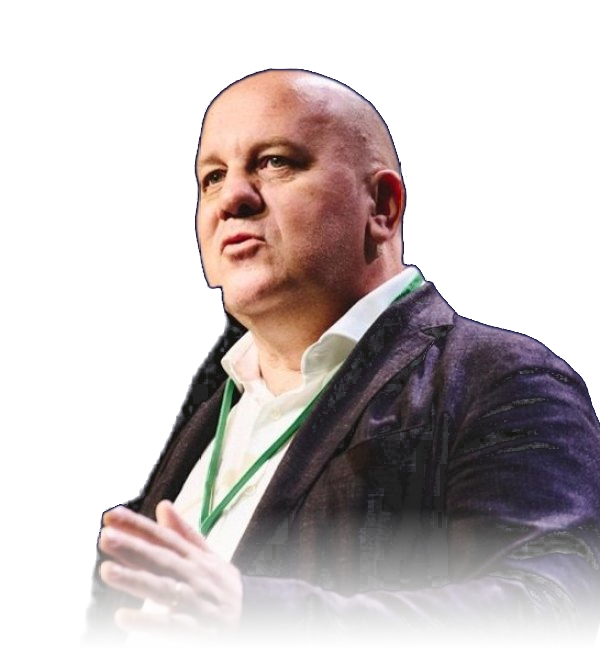
Christophe Jurczak is the managing partner of Quantonation, the early-stage venture firm he co-founded in 2018 to back quantum and deep physics startups. A physicist by training, he did his PhD with Alain Aspect in the late 1990s. Across two funds, Quantonation now manages a little over €250 million and has invested in 35 companies worldwide, including Pasqal, which it backed in April 2019. We talked in July 2025. We covered why quantum startups stall between Series A and Series C, what turned Pasqal from a lab experiment into a product, why quantum still needs its ChatGPT moment, and why sensing may be the field's most overlooked opportunity.
What Christophe said in the clips
What Quantonation does
Can you introduce yourself and Quantonation?
I'm Christophe Jurczak, a managing partner at Quantonation. We're a firm based in France and the US, with two funds under management, Quantonation I and Quantonation II, managing a little more than €250 million for now. We've invested in 35 companies worldwide, focused on quantum technologies and deep physics, plus enabling technologies, both software and hardware. So we're very focused on the quantum revolution.
The funding gap in quantum
What's the biggest gap in funding today, especially for helping startups scale beyond the seed stage?
The venture and funding ecosystem is quite healthy for early stage. Where companies struggle is moving from Series A to Series B and Series C: scaling, raising more capital, and showing revenues, which is what investors are looking for. That's challenging for this kind of technology. Not for everything: hardware in particular is harder. In software you can have different strategies, generating revenues with hybrid approaches, for example. But the challenge is definitely scaling, and raising large amounts to fund hardware in the later phases of a company's life.
Europe, the US and Asia
What differences do you see between North America and Europe?
Europe has been really strong at creating new companies since 2018 and 2019, with IQM, Pasqal, planqc and others. There's a very strong ecosystem for early-stage funding, in particular with the European Innovation Council funding many of these companies.
The question is how to get to the next phase: how to fund the Series B and Series C, the hundreds of millions these companies will need. That's where Europe is a bit more challenged, with fewer investors committed to late-stage technology funding. In the US you have more opportunities, more investors used to that, and public markets. Some quantum companies have gone public in the US. In terms of use cases, algorithms, competencies and talent, it's very comparable. It's really about funding, getting to the next phase, and building global leaders. That's where Europe should focus.
And Asia?
There are new companies, new projects and very interesting ecosystems: Singapore, Japan, Australia. We're investing in Diraq in Sydney, for example, and a few weeks ago we announced a partnership with Deloitte Tohmatsu to work on the Japanese quantum ecosystem together. Quantum has come in waves of company creation, and it's definitely not too late. There's outstanding science in Singapore, Japan and Australia in particular, so there should be more companies.
From science to market
Quantum startups often emerge from academic research. What are the most critical challenges in turning science into a scalable business?
At the beginning, the challenge is that we only have science. There's no product yet, and it usually takes years to reach product-market fit. Sometimes people focus a little too much on applications, when they still need to develop the science and the technology. What matters most to us is that the founding team has a vision of the pressing need they're addressing.
A key challenge for VCs is that we're looking for sizeable markets. Sometimes academics bring us projects that are too narrow, focused on small niche applications, like selling to other academics. That's not a good thesis. We want large markets. It might take five years, ten years, even more. But we need a big vision from the founders, solving big challenges.
Quantum for good
How does Quantonation integrate societal impact into its investment decisions?
Some applications we're very interested in are healthcare and the energy transition. For example, we've invested in a company in France called Pioniq Technologies that develops quantum materials for energy storage: safer, cleaner alternatives to lithium and cobalt. In healthcare, there are many interesting use cases, like getting to new drugs faster with quantum computers and hybrid approaches.
Last year we organized a workshop in France on climate tech, climate mitigation and quantum technologies, under the patronage of Professor Alain Aspect. It's a tough topic. Quantum is not going to solve every problem, that's for sure. But we believe that in the toolbox, there will be quantum technologies.
Quantum and AI: the hybrid future
What trends are you seeing at the intersection of quantum and AI? Are we still in the exploratory phase?
I think we're past the exploratory phase. A few years ago people talked a lot about quantum machine learning, and it was a little vague. It's much clearer now how quantum and AI work together, and that's part of our thesis.
We need quantum to solve certain problems where AI alone isn't efficient. Look at the time, the energy and the cost of training large language models: hundreds of millions of dollars. We need alternatives, and we believe quantum can be part of the solution. One very interesting application is using quantum computers to generate synthetic data, then training foundation models on it. That will matter for materials design, and we already have some evidence. We also have portfolio companies using concepts from quantum science, running on GPUs rather than quantum computers, to compress large language models.
The keyword is hybrid. You have to use all the resources you can, quantum processors and classical processors, but with a quantum-oriented mindset.
Pasqal: from lab to product
Can you share a success story from your portfolio, from scientific breakthrough to commercial product?
Pasqal, from our first fund. We invested quite early, in April 2019. They build quantum computers made of neutral atoms manipulated by laser light. At the beginning it was more challenging: people were afraid it wouldn't scale or reach the fidelities we need. But the company, and its competitors too, have proven the technology is very scalable. Pasqal has shipped machines and put them into operation in supercomputing centers in Europe, and soon in Saudi Arabia.
Engineering is the keyword. These machines have to work all the time. They have to be put in a truck or a plane, shipped, delivered, and function.
What's the one thing that made Pasqal successful early on?
The focus on engineering, on building products. A neutral-atom experiment is full of mirrors. It's very complex, you can't move it or ship it easily, and maybe it works 20% of the time. The focus from the start was to turn that into a well-engineered, ruggedized product that works most of the time. Maybe not 99% yet, but with good availability, something you can rely on. It's not a lab experiment anymore. It's a product.
Quantum needs its ChatGPT moment
What should the quantum VC community and startups do to better engage the public and policymakers?
The community is not very good at crafting the message about the use cases and impact of quantum technologies. We need more interdisciplinarity: quantum scientists, of course, but also computer scientists and experts in the application domains. It's not just a question of physics. We want to build companies and products for a benefit, and the community isn't always clear on that.
In quantum computing, we're reaching quantum advantage within the next couple of years. But we need more obvious use cases, a little like the ChatGPT moment in AI. We're not there yet. In quantum we don't have a retail application; it's mostly B2B industrial use cases, so it's hard for people to relate. We need more effort on applications closer to the citizen.
When quantum advantage arrives
A lot of people talk about quantum advantage. How do you see it happening, and on what timescale?
We already have quantum advantage in some special applications in science, using quantum processors for fundamental physics and condensed matter physics. That doesn't sound like a big deal, but it is.
For me, the low-hanging fruit is materials design. I believe that's coming, and that we'll bring these technologies to market over the next two years maybe. But you have to think in terms of combining technologies, not quantum alone. Quantum is part of a complex workflow. Maybe it's 10% of the workflow, not more, but that will be sufficient. We need to see these technologies in production, in materials design, drug design and chemistry. That's where the short-term applications will be.
Quantum-inspired approaches, like what Multiverse Computing is doing, are already working now, and it's really impressive. And it's not only quantum computing: there are interesting developments in quantum communications and quantum sensing too. I believe we'll see more of them reach maturity before the end of the decade.
The overlooked opportunity: quantum sensing
Is there an area in quantum that's underfunded but holds real promise?
Quantum sensing is intriguing. The technologies are more mature, using synthetic diamond in microscopes, for example, or for navigation, and the applications are rather clear. But it's been quite challenging to build large companies in that segment. Companies tend to be small and focused on niches. Very interesting applications, but deployment has been tough.
We believe there should be a better model for building quantum sensing companies. Again, maybe hybrid is the word: multi-sensing, classical and quantum together, with a data processing layer. More complex companies, but we believe they can succeed. Some applications, like brain-computer interfaces using quantum sensors, are maybe a little bit science fiction and a very long-term play. But that's the kind of ambitious project that could reach large markets.
Building the quantum ecosystem
What role should co-investors, corporates and governments play in building a strong quantum ecosystem?
We believe we need to create more companies. Some come to us, created by founders, mostly at universities, but there's more we can extract from university science. So we created venture studios: partnerships with governments, in France and in Canada with the province of Quebec, with local investors working with us. It's starting to be really successful. In Sherbrooke, for example, the province of Quebec has put a very nice ecosystem in place with dilution fridges as a service, which companies can rent instead of paying the high capex for that equipment. We believe that model can be replicated.
The second aspect is getting to applications, and that's where we need corporates. They can invest in a fund, like the Novo Nordisk Foundation or Toshiba, and work with startups in our portfolio. Mature companies can do it on their own, but in the early days they struggle with how to engage corporate customers, and we help with that.
Last, public procurement is super important. The quantum computing market is largely a market of buying machines for supercomputing centers, so startups need relationships with governments at the highest level. We help build those connections around the world: Europe, North America and Asia-Pacific.
Who is best suited to bring all these technologies together?
It's really the ecosystem: VCs, governments, all of it. We talk about co-design centers, places, real or virtual, where different kinds of talent collaborate toward a specific application. That's the important part: don't be too vague. Look for places where quantum could have an advantage, focus on that, and bring the talent, the algorithms, the machines, the governments and the VCs together to get it done.
This interview has been edited and condensed for clarity.

