
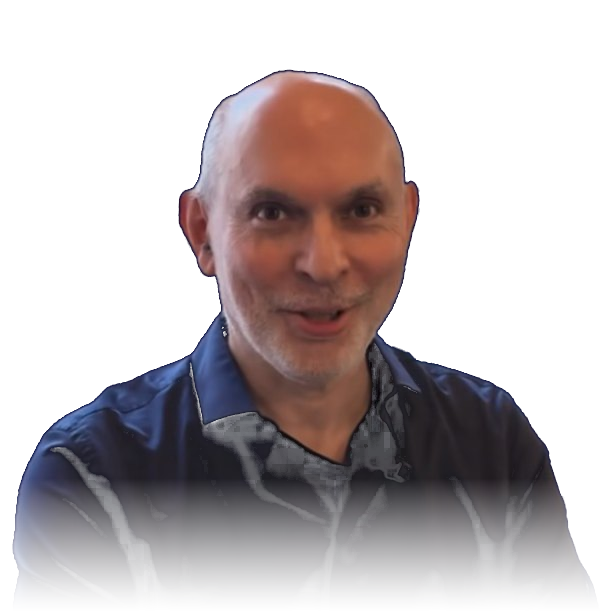
Olivier Ezratty calls himself the Swiss Army knife and free electron of the quantum field. He teaches quantum physics and quantum computing at schools like EPITA and the École Normale Supérieure, and he wrote Understanding Quantum Technologies, a free, open-source book of some 1,500 pages that many in the field treat as its encyclopedia. He also co-founded the Quantum Energy Initiative, which works to make sure quantum computers don't become the next energy hogs of IT. We talked in September 2025. He explained why quantum's energy footprint matters now, why the field is so hard to explain to the public, and why quantum has been the most passionate chapter of a long career in tech.
Clips coming soon.
What Olivier said in the clips
A Swiss Army knife in quantum
Can you introduce yourself?
I'm Olivier Ezratty. I'm a kind of Swiss Army knife and free electron in the quantum field. I'm mostly an academic now: I teach quantum physics and quantum computing at schools like EPITA and the École Normale Supérieure. I wrote a book that is starting to be known, Understanding Quantum Technologies. It's open source and free, and it's very long: 1,500 pages. Some people call it the bible or the encyclopedia of quantum, because it covers a lot of topics.
I also do freelance research with a couple of physicists, and I co-founded the Quantum Energy Initiative, a group of academics and industry vendors looking at the energetic impact of quantum technologies. We want to optimize it, to make sure we don't create new energy hogs in the IT world. It's very interesting because we need to connect the dots between multiple fields: fundamental science like quantum thermodynamics, engineering like error correction, and economics.
Why care about energy this early
When you started the Quantum Energy Initiative, how did people react?
When we started three years ago, the main reaction was: "It's too early to care about that. Let's make it work, and then we'll look at the energy." We were four co-founders: Alexia Auffèves, who leads a lab in Singapore; Robert Whitney, an English physicist working in Grenoble; Janine Splettstoesser, a German scientist at Chalmers in Sweden; and me. So it's very international.
We thought it made sense to look at this topic early. Look at the history of AI: it became a real energy hog, particularly once it became a widely used consumer tool with LLMs. If you care about the environmental impact of a technology while you design it, you will be in a better position to make sure it's clean, to some extent.
There's a side effect, too. It forces people to have a holistic view of a complex system that integrates software, hardware, physics, electronics, cryogenics and economics. It drives a new scientific approach to optimization, and it may even drive the choice of some technologies in the design of those products.
Hard to explain, not yet in our lives
There are many initiatives to educate the public about quantum. Why is it so hard?
There are two reasons. First, it's more complicated than classical information technology. You can argue about this, but quantum physics is, whatever you say, counterintuitive. And beyond the physics, there are a lot of new concepts all over the place. Even computer scientists find quantum tech difficult. So imagine someone who doesn't even know how their own smartphone works.
Second, it doesn't change people's lives yet. The technology is still under development, at a low technology readiness level. So people say, "Okay, maybe someday I'm going to understand that."
One way to get people interested is to tell them: "You may not know it, but your smartphone, your laptop, your fiber optic line at home are based on quantum physics." People say, "Oh, I didn't know that." Then you can explain what's going to change with the second quantum revolution, a term crafted by Alain Aspect and others about 20 years ago.
The most passionate chapter
Why should people get into quantum?
I think the main reason is that it forces you to brainstorm more than many other domains, and it opens the door to connecting the dots between multiple scientific fields. Say you're into chemistry: you'll use quantum computing to do quantum chemistry, assembling multiple domains. Say you're a software developer: quantum software is a totally different paradigm. It will twist your head a little, but it will keep your brain flexible.
Whatever your field, it will push you to be more multidisciplinary. You can do a master's and a PhD in academia, or you can work for a vendor, like a startup. In a young startup, a few people do multiple jobs at once: communication, science, engineering. So you have even more room to move from one discipline to another, and it expands what's possible in your career.
I've been through a lot in information technology: AI, semiconductors, consumer electronics, digital television, marketing. I'm towards the end of my professional life. And my life in quantum in the last seven years is the most passionate that I have ever had. On top of that, I wrote a book that's read around the world. From a scientific and engineering standpoint, it's really a boon. It's a huge opportunity.
This interview has been edited and condensed for clarity.

