
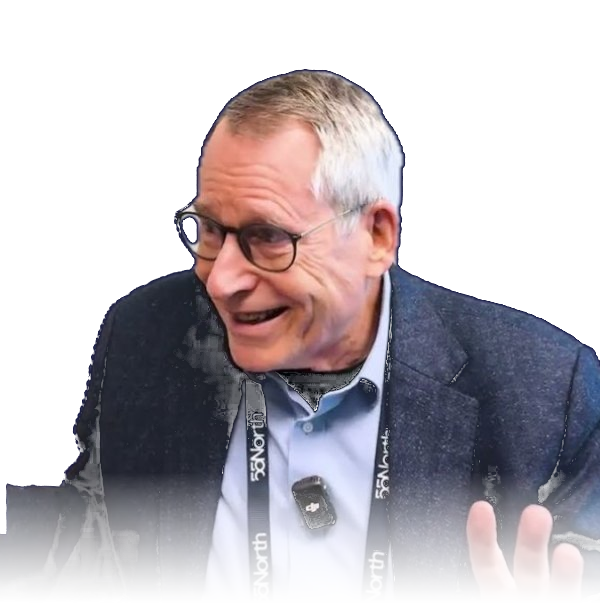
John Preskill is the Richard P. Feynman Professor of Theoretical Physics at Caltech, where he arrived in 1983 and overlapped with Feynman himself. He started in particle physics and cosmology, then turned to quantum information in the 1990s, after Peter Shor's factoring algorithm. He coined two of the field's defining terms: "quantum supremacy," in 2011, and "NISQ," which he introduced at the very first Q2B in 2017. We sat down at Q2B Silicon Valley in December 2025. We talked about the cancelled collider that pushed him toward quantum information, the paper he dismissed in 1985, the word "supremacy" he would perhaps choose differently today, why neutral atoms may lead the way to fault tolerance, and why curiosity-driven research still matters most.
The interview
From the Space Race to quantum information
You started in physics as a student in cosmology. What was that like?
I became aware of science in the 1960s, as a kid, because of the Space Race. It was very exciting. We were going to go to the Moon, and that ignited my interest in technology and scientific ideas. By the time I was about 10, I knew that was what I wanted to pursue.
As a student, I felt the most exciting things in physics were the most fundamental questions: how matter works at a microscopic scale, and what happened in the universe right after the Big Bang. That was the focus of my research early in my career. Then in the '90s I got excited about quantum information, and that's been the main focus of my scientific work for about 30 years.
There were a couple of setbacks in physics theory around that time. Is that why you made the switch?
That's a psychological question, so it's hard for me to give a definitive answer. But for my generation of particle theorists, we were very excited about the Superconducting Super Collider, the next-generation particle accelerator already under construction in the United States. They had spent a couple of billion dollars digging a big hole in Texas. We thought it would answer some of the questions I'd been curious about since the start of my career.
The project was cancelled in 1993, for political reasons. It would take another couple of decades to have a machine that could explore that physics, which turned out to be the Large Hadron Collider at CERN. So I was doing some soul-searching.
I had developed an interest in quantum information, not because of quantum computing, which I didn't see as promising in the early '90s, but because of black holes: how they behave quantumly, and what happens to information that falls inside one. That's how I got acquainted with how quantum information is stored and processed. It prepared me so that when Peter Shor discovered in 1994 that, at least in theory, a quantum computer could factor large integers very efficiently, I was fascinated and wanted to understand it. That steered me into quantum information.
What excites me as a physicist about quantum information, then and now, is that it gives us a new way to explore nature in a regime we've never had access to: many particles interacting quantum mechanically, in a state so complex that we don't know how to describe it in the language of bits, the language our computers and we humans understand.
Science first, business later
There's enormous industry interest in quantum computing. Where do you see the first real applications?
You can understand the interest: it's a whole different way of processing information, and people know computation matters. But my feeling is that for a while, the main things quantum computing lets us do that are new will be scientific. Whether they'll be commercially viable is less clear.
That's okay with me. The same thing happened with conventional computing. In the '40s and '50s, people were excited about computers because they could solve scientific problems that had required too much computational power. Who could have said back then what we'd be using computers for now? I think the same will happen with quantum computing. The early applications will be scientific, and they'll pave the way for applications with a broader impact on people's lives.
For a professor, that may be fine. But startups need money to scale their hardware, so they have to sell commercially useful applications.
That's right. We used to talk about a possible "quantum winter": high expectations would be frustrated, and when investors realized commercial utility would take longer, interest would collapse.
I'm less worried about that now than I was a few years ago. It's going to take a while, but I think we'll make incremental progress that keeps the field surging forward. There are hundreds of startups, and they won't all succeed. That's the nature of startups. But the big companies investing won't just say, "Okay, it's time to go home." They'll see the potential is there and keep investing. And for them, the scale of investment, enormous as it seems to physicists, is not so big compared to what's going into classical machine learning and AI.
Feynman, and the paper he dismissed
Early in your career, you overlapped with Feynman, who was talking about quantum machines. What were those conversations like? Did people think he was crazy?
Let me tell you a story that's a little different from what you asked. When I was about 10, one of the things that inspired me was a book called The World of Science, which covered lots of scientific fields. The chapter I found most interesting was about theoretical physics. It didn't name them, but it was based on interviews with Richard Feynman and Murray Gell-Mann, both at Caltech. In fact, every chapter was based on interviews with Caltech faculty.
It had an enormous impact on me. It focused on the amazing fact that the laws of physics look different in a mirror, what we call parity violation. It just blew my mind. Only years later did I realize it was based on interviews with Feynman. So he had an impact on my life when I was 10.
Another 20 years go by, and I'm his colleague on the Caltech faculty, with Murray Gell-Mann there too. It was pretty cool. I arrived in 1983, and Feynman died in 1988, so we overlapped for four and a half years. We interacted a lot, but we never talked about quantum computing. I wish we had! We talked about particle physics, which we were both interested in.
Why not quantum computing? Because I didn't think it was interesting in the 1980s. I was steered toward a paper by David Deutsch from 1985, which I can see in retrospect was very visionary. He described how quantum computers might solve problems that would be too hard otherwise. But I got the wrong impression that he was really describing what a computer scientist would call randomized computation, where at each step you flip a coin to decide what to do next. I knew that wasn't so powerful, so I thought maybe this quantum stuff was just fancy words for randomized computation, and I dismissed it. That was a mistake. It wasn't until Shor's algorithm that I appreciated there was really something to it.
If the John of the '90s walked the floor of Q2B today, what would shock him most?
I don't know if "shock" is the right word, but two things surprised me along the way.
One was how quickly industrial interest ramped up while I felt we still had a long, long way to go. Starting about 10 years ago, and accelerating for a few years after that, companies suddenly took it really seriously.
The other has to do with the quantum properties of space and time. I'm still interested in black holes. When I started in quantum computing, nobody working on quantum gravity cared a hoot about it. That changed. We realized that ideas from quantum computing, including quantum error correction, are very useful for thinking about the quantum mechanics of spacetime itself. It was interesting to watch that transition.
Naming "quantum supremacy"
You coined the term "quantum supremacy." Did your standing as a leading scientist help the industry take off?
People started using the term. It came from talks I gave starting in 2011, especially one at a Solvay conference in 2012. Both were to scientific audiences, and I was trying to get across that this is a very special time in the history of technology on Earth: for the first time, we're able, or soon will be, to do things with quantum machines beyond anything conventional computing can do.
After thinking about other terms, I said "supremacy" to emphasize that big disparity between what quantum and classical could do. Maybe it was an unfortunate choice, in two ways. It may have hyped things too much, though for a scientific audience that seemed fine. And the word "supremacy" is politically odious, which I wasn't thinking about at the time.
But it did have an impact. To be clear, it wasn't a new idea. From the beginning, people talked about doing things with quantum machines we couldn't do otherwise. What I was saying is that in the near term, those things don't have to be practically useful. They can be scientifically interesting. Even that wasn't new, but maybe it had some influence.
The NISQ era, and beyond
You also coined "NISQ," noisy intermediate-scale quantum, the era we're in now. What are its challenges and opportunities?
I proposed that term here at Q2B, in December 2017, at the first Q2B. I wrote the talk up as "Quantum Computing in the NISQ Era and Beyond," and an important part of it was the "and beyond."
I was saying we'd have technology able to do some things beyond conventional computers, and that this would be a period of exploration to understand what those things are, and whether any have economic utility. I also said that any applications would be limited, because we wouldn't be able to do very large-scale quantum computations. Perhaps beyond what we can simulate classically, but nowhere near the scale we want for applications.
So we have to keep our eye on the transition from NISQ to what lies beyond, and that means error correction. I've been interested in quantum error correction since I got into the field in the '90s. We knew it would matter someday, but it was a ways off. I didn't mind. As a theoretical physicist, I'm used to talking about things no one will do in the lab for decades, and I think that's important. It's fine to see what we can do with NISQ machines, because that's what we have, but let's not lose sight of the real goal: the transition to the fault-tolerant era. We're in the midst of it now, so it's an exciting time.
In our quantum computing class this year, there's a huge emphasis on error correction. People here say young professionals should really look into it.
I've been at Q2B every year since it started. In the first few years, everybody talked about NISQ. A few years ago, it tipped toward a general recognition that broad applications will require error correction. That seems widely accepted in the industry now.
Simulating matter, and quantum AI
In your talk this morning, you said you weren't excited about applications a few years ago, but you are now. Is that because of better machines and error correction, or is AI part of it too?
Let me clarify. I meant I wasn't personally interested in running applications on the quantum platforms we had a few years ago. I'm more interested now because they've reached a scale where they're scientifically more powerful.
For physicists, it's interesting to know what kinds of matter could exist that we haven't discovered in the lab yet. That's what simulations on quantum computers can tell us. Even for models of quantum matter studied for years, there are properties we haven't been able to compute, because they're so hard to simulate classically and our theoretical methods have limits. Now we're starting, to a limited extent, to learn some of those properties.
We'll need error correction to go much further. In the talk, I mentioned simulating a lattice of fermions. Fermions matter for chemistry, electrons and materials, and they're notoriously hard to simulate on conventional computers, so that's where quantum computers could have an advantage. It's still small-scale, a lattice of 36 electrons, but that's already hard to do exactly classically. We can now compare quantum runs with the best classical heuristics, and since we don't have a good way of characterizing how accurate those heuristics are, that comparison is interesting.
As for AI: it's obviously changing the world, and quantum hasn't reached that stage. Combining the two interests me, but we have a limited understanding of quantum AI's potential, because theorists try to analyze it with rigorous mathematics: prove a theorem that some application is hard classically and doable quantumly. That's really hard to make convincing.
In classical computing, people just tried things, and sometimes they worked. That's especially true in AI. We don't really understand why classical AI can do what it does. What finally made it work was scale. The theoretical ideas were pretty old, but people kept trying, and suddenly there was wide-ranging practical impact. Quantum AI may be similar. There are a few ideas for combining the two that aren't well fleshed out mathematically. Eventually we'll try them, but we'll probably need error-corrected quantum computers to reach a scale where it gets interesting.
Say you go back to your office tomorrow and find a NISQ machine. Which physics simulation would you run?
I can answer that concretely, because we're actually using these machines in my group. Given my background in particle physics, I'm interested in using quantum computers to simulate quantum field theory, the language of most of physics.
Some things can be computed with large-scale classical computation, and some are just too hard, typically dynamical processes. In a particle collider, you bang two protons together at extremely high energy and produce lots of particles. We know the right equations, quantum chromodynamics, but we can't predict from first principles exactly what will come out. It's too hard to compute.
That's a long-run application for quantum computers. But I think we can learn things about particle physics from quantum simulations well before full-blown quantum chromodynamics. We've run applications on an IBM machine, and we're about to try another platform. For the processes we're studying, classical methods are still better, but that will change. We'll see how far today's machines can go, and maybe that will point us to where quantum advantage becomes scientifically informative.
Why neutral atoms may lead
And what about neutral atoms?
I think they're extremely promising, and it's an interesting story. When I first spoke at Q2B about NISQ, I wasn't thinking about neutral atoms in optical tweezers. They weren't on most of our radar screens, and people couldn't do circuits with them.
Only about four years ago did people first run programmable circuits with atoms in optical tweezer arrays, and it has progressed very quickly. One of my Caltech colleagues now has a system with 6,000 atoms in tweezers, and work is under way to turn it into a processor. Fidelities still lag a little behind superconducting and trapped-ion processors, but they're improving.
You can have thousands of atoms, and they're reconfigurable, so you're not limited by geometric locality the way a typical superconducting processor is, where only nearest-neighbor qubits can interact in a gate. We're understanding that reconfigurability is an advantage for fault tolerance. I expect progress toward error-corrected quantum computing to be led by neutral-atom processors for some period of time. I'm not saying they'll be the answer in the long run, but I think they're really ready to take off.
They also use less energy. Someone mentioned yesterday that neutral atoms are among the lowest.
And they're not very expensive to build. There are companies pursuing the technology, but the main innovations of the last few years are coming from university groups. It's a modality driven by innovation, not by who can spend the most. A few graduate students can set up a lab for a few million dollars and do state-of-the-art computations. With a lot of money, you could build a hundred of those and go crazy.
Wisdom for the quantum explorer
You closed your talk with "good fortune for the quantum explorer." You've lived through quantum information theory, the NISQ era, and now the move to fault tolerance. What wisdom do you have for living through this transition?
Keep in mind that all of this came from fundamental, curiosity-driven research: people trying to understand what nature can do.
Shor's algorithm was immediately recognized as something that could change the world, but the first processors were adaptations of technology that existed for other reasons. People studied superconductors as a way to explore quantum mechanics, and trapped ions as a way to make better clocks. Those foundations were laid by research that wasn't aiming to be commercially valuable.
I think that will stay true. In the grand scheme of things, we're still early. It's really exciting now, and things are advancing quickly. But we still need a lot of innovation to realize our aspirations in quantum technology, and we have to keep nurturing fundamental research, because that's what will create the great technological opportunities further out.
We tend to underestimate how fast technology changes our lives. In 50 years, what's the biggest difference quantum computers could make?
On a 50- or 100-year time scale, we can't possibly imagine how the world will change. That's especially true of quantum technology, because it's such a different way of dealing with information: storing it, processing it, and detecting it. Quantum sensing is another interesting part of the story. It's so different from anything we could do before that we're especially limited in our ability to imagine the future.
This interview has been edited and condensed for clarity.

