
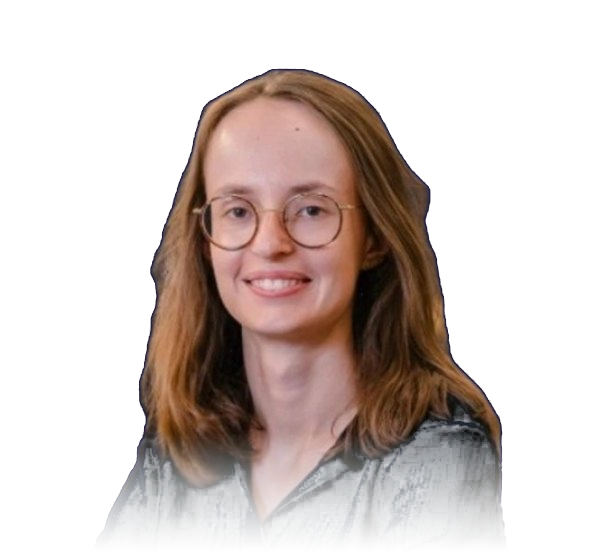
When we spoke, Cassandre Notton was a quantum machine learning engineer at Quandela, a French full-stack quantum computing company that builds photonic quantum computers. She trained as an engineer in France and wrote her master's thesis on self-supervised learning for colorectal cancer detection, then joined Quandela for a new challenge. Her first project there helped Quandela win the BMW x Airbus international quantum challenge. We talked in May 2025, when she was working from Montreal, where Quandela had recently opened its Quebec subsidiary. She was TQR's very first guest. We talked about what quantum machine learning really is, where the field honestly stands, and how a hybrid quantum model turned daytime images into nighttime ones.
What Cassandre said in the clips
What is quantum machine learning?
How would you explain quantum machine learning to someone with a strong tech background but no quantum experience?
I'll try to explain it the way I understand it now. In machine learning, most of the time we're working with algorithms built from linear layers, like MLPs or convolutional neural networks. In quantum machine learning, we're trying to take the most out of machine learning and the most out of quantum computing, and leverage machine learning with quantum computing.
By leverage, we mean: can we train with less data? Can we save energy? Can we train faster? Can we train better? Is there a way quantum computing will let us see patterns in the data that we didn't know existed?
It's like Lego bricks. We have the bricks of machine learning, we have the bricks of quantum computing, and we're trying to merge them to build a better framework.
What would you say is the biggest advantage of quantum versus just machine learning?
We still need to benchmark. There's a lot of literature on quantum machine learning, but results really depend on the hardware, and on whether you're running in simulation or on a real device. We do see some advantages, but we have to take precautions.
Quantum machine learning today is still where I think machine learning was 12 or maybe 20 years ago. We're working on toy datasets: spirals, moons, MNIST, the datasets machine learning used years back. We're going back to the foundations and asking what it really means. Sometimes we see advantages, but we need to be cautious. We need to benchmark, and ask whether the comparison is fair. Sometimes it doesn't work, and I think it's important to acknowledge when it doesn't.
Inside Quandela
For those unfamiliar, what does Quandela do, and what makes its technology unique?
Quandela is a full-stack quantum computing company. We have the hardware: a quantum computer based on photons. The core technology is the quantum dot, a way to make single photons. Around that hardware we have software, which lets you either simulate the quantum computer on your local machine or send your code to the real one. It's open source, and it's in Python.
Because we have the software and the hardware, we need a theory team to write algorithms for the device. And once we have the algorithms, we need an applications team to find real-life use cases for them. That's why we're full stack: we do everything from the hardware to the use case.
Where is the quantum computer, and can you access it remotely?
We have computers in France, up to 12 qubits, that you can access through Quandela Cloud. You can register now and get free credits the first time you run algorithms on them. We also have a QPU in Sherbrooke, which you can access through Quandela Cloud or through a partner platform. They're very easy to access, and you can run code on them in Python.
Where quantum computing really is today
Where do you think we really are in quantum computing today? There's a lot of hype. What's the reality of working in the field?
We have amazing theory. We have wonderful algorithms, Shor's algorithm for example. But we also have noisy hardware. We're in the NISQ era, which stands for noisy intermediate-scale quantum. All the quantum computers from all the companies worldwide have noise. They don't have many logical, error-corrected qubits yet.
So I'd say we're at the stage of quantum readiness, where we can show things on toy use cases. That's why we need to onboard quantum computing now. If we can show that it works on small use cases, then when quantum computers get bigger and less noisy, we'll be able to show bigger things.
I'm not sure there is a hype. I think industry is taking precautions, because they don't yet see the added value. So we need to onboard them now, teach them, and walk with them toward a quantum-ready future.
Winning the BMW x Airbus challenge
How do you use quantum to make AI better, and how do you benchmark something so new?
The project I joined when I arrived at Quandela was an international challenge led by BMW and Airbus. The goal was to translate daytime images into nighttime images, which AI models like CycleGAN already do. Our approach was to take CycleGAN and see where we could add quantum bricks to improve it, either by reaching the same performance with less data, or by getting better performance.
We added the quantum brick roughly in the middle of the CycleGAN, in its latent space, and we observed better outputs in terms of light exposure. Some of the daytime images were overexposed, which made the nighttime translation hard for the machine learning models. With quantum, it was easier.
We ended up winning the challenge. I think it was because of our original approach, a hybrid model, and because we stayed honest. We said: these are the only experiments we've done, and we still need to compare them properly to have a robust scientific study. We highlighted the limits. And there's the beauty of it: a hybrid model is the best of machine learning with the best of quantum computing.
Was it a team effort?
We were a lot. It merged software, theory and applications. It was the complete team, with all the expertise we needed from Quandela.
You're smiling just talking about it. What was the most thrilling part?
Getting to the bottom of the classical model. We dissected the classical machine learning model, explained what each part was doing, and discussed whether it would make sense to add quantum there. Layer by layer, skip connection by skip connection, we'd say: maybe here, hypothetically. Here, definitely not. Then we'd test. Sometimes it didn't work at all, and sometimes it worked.
This interview has been edited and condensed for clarity.

